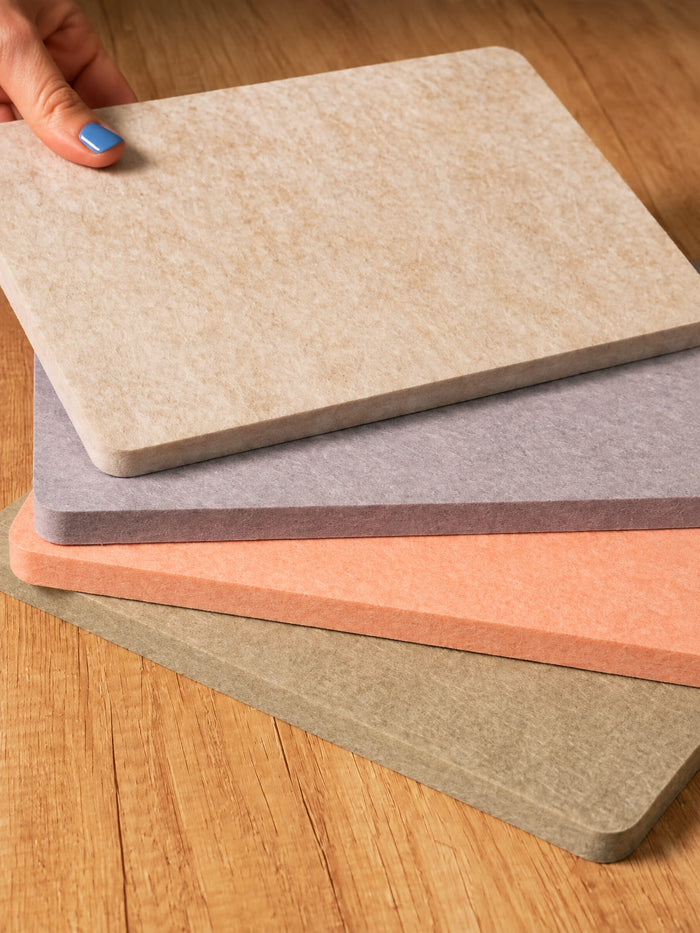
Acoustic Panel or Soundproof Panel?
What Is the Difference Between Sound Absorption and Sound Insulation?

Sound-absorbing materials take energy out of sound inside a room. Fibers vibrate, or sound enters a network of pores and is reflected many times inside the material. Less sound bounces back, so speech and other sounds in a given frequency range stay clearer.
These materials are usually porous at the surface, and they are often relatively light.
Sound insulation does a different job. It reduces the sound that passes through a wall, floor, ceiling, or door. A good insulating construction is heavy for its area — it has a high surface density — and every gap that could leak sound has to be sealed.
The drop in level from the side the sound hits to the side it comes through is the sound reduction, measured in decibels. In specifications, this weighted single number is usually written Rw (dB).
Absorption and insulation are not the same thing. A panel that reduces echo inside a room does not, by itself, stop noise from reaching the next room. In real projects the two are often used together: insulation limits what passes through the structure, and absorption controls what keeps bouncing inside the space.
How Sound-Absorbing Materials Are Classified

Porous materials
A porous absorber has many small, interconnected pores from the surface through the body of the material. When sound hits the surface, it moves the air inside those pores. The air rubs against the solid structure. That friction turns part of the sound energy into heat, so less of it is reflected.
Polyester acoustic panels and fabric-wrapped acoustic panels are typical porous products.
Resonant structures
A resonant absorber is built to respond at particular frequencies. Slots, perforations, or a panel face move with the sound. An air space behind the face — often with a porous fill — dissipates the energy. The face, the cavity, and the fill work as one structure, not as a solid board.
Wood acoustic panels are the usual example: slotted or perforated wood in front of a cavity. They are used when a room needs absorption and a wood finish.
Frequency: Which Sounds Matter in a Room

Sound starts as vibration. Frequency, written f, is how many times that vibration happens per second. The unit is the hertz (Hz).
People do not hear every frequency. Hearing is generally limited to about 20 Hz to 20,000 Hz. Below 20 Hz is infrasound. Above 20,000 Hz is ultrasound. Neither produces the sensation of sound for a typical listener.
In building acoustics, bands are grouped roughly like this:
- Low frequency: about 200–300 Hz and below
- Mid frequency: about 500–1,000 Hz
- High frequency: about 2,000–4,000 Hz and above
For speech and everyday listening in a room, the range that usually matters most is about 100–3,150 Hz. When a project looks at the broad band used in rooms, that span is often treated as about 100–8,000 Hz.
The same panel does not absorb every band equally. A product photo alone cannot tell you whether a panel will control a low rumble or a high flutter echo.
Sound Absorption Coefficient (α)

The absorption coefficient, α (alpha), describes how much of the sound that hits a material is not reflected. It is the ratio of absorbed sound energy — including energy that passes through the material — to the total sound energy that arrives.
α depends on the material and on how it is built. For the same material it also changes with frequency and with the angle at which the sound arrives. One product therefore has different coefficients at different frequencies.
To make comparison easier, specifications often average the coefficients at six frequencies: 125 Hz, 250 Hz, 500 Hz, 1,000 Hz, 2,000 Hz, and 4,000 Hz. That arithmetic average is the average absorption coefficient.
In engineering practice, a material with an average absorption coefficient above 0.2 is treated as a sound-absorbing material. An average above 0.5 is considered a strong absorber.
An average is only a summary. Check the coefficient at the frequency the room actually needs to control before you compare two panels.
Noise Reduction Coefficient (NRC)

NRC (Noise Reduction Coefficient) is a single mid-frequency number. It is the arithmetic average of the absorption coefficients at 250 Hz, 500 Hz, 1,000 Hz, and 2,000 Hz, rounded to the nearest 0.05.
NRC is useful for a quick comparison. It does not describe low-frequency performance, and it does not replace a full set of coefficients when a project has a specific noise problem.
NRC is also not a sound-insulation rating. Rw describes transmission through a construction. NRC describes absorption inside the room.
Sound Pressure and Sound Pressure Level

Air already presses on everything around it. That steady pressure is atmospheric pressure. Sound travels as vibration in the air, and the vibrating air adds a small extra pressure on the surfaces it reaches. That extra pressure is sound pressure.
Sound pressure is tiny next to atmospheric pressure. A sound pressure on the order of one ten-thousandth of atmospheric pressure is already high enough to put hearing at risk.
Because the raw numbers are awkward to use, loudness is described as sound pressure level (SPL). A very small reference pressure, p0 = 2×10⁻⁵ Pa, is the baseline. SPL is 20 times the common logarithm of the measured pressure divided by that reference:
SPL = 20 × log10(p / p0)
The unit is the decibel (dB). Sound pressure level describes how loud a sound is. It is not the same as Rw, and it is not the same as NRC.
What to Check Before You Specify a Panel

Use absorption when the problem is inside the room: echo, muddy speech, a hard ceiling. Use insulation, mass, and sealed joints when the problem is sound traveling into another room. Many projects need both, and they are specified with different numbers.
- α at each frequency shows where the panel absorbs
- The six-frequency average, and NRC, are summaries of that absorption
- Rw describes how much a construction reduces sound passing through it
- dB describes how loud a sound is, not how a product performs
Match the number to the problem. Reverberation inside a room and noise passing through a wall are not solved by the same figure.