3D PET Acoustic Panels: A Specifier's Guide to Design, Performance and Ordering
What Are 3D PET Acoustic Panels?
3D PET acoustic panels are sound-absorbing panels made from recycled polyester fiber, with a profiled or layered face instead of a flat one. The sculpted surface breaks up the wall visually while the porous material absorbs sound inside the room.
They are used where a wall needs to work as both acoustic treatment and design feature: reception areas, boardrooms, feature walls behind a desk, restaurant interiors, hotel lobbies and showrooms.
The difference from a flat panel is the profile. A flat panel gives you an even surface and a predictable absorption curve. A profiled panel gives you depth, shadow and pattern, and the acoustic result depends on how much of the surface is built up and how far it stands off the wall.
How the 3D Profile Affects Performance
Two things change when a panel gets a profile.
The air cavity behind it. Any absorption material performs better when it stands off a hard wall rather than sitting flat against it. Sound passes through the panel, hits the wall, and passes back through the material. A gap gives that wave more material to travel through, which is why the same panel often measures better mounted on a bracket than glued flat.
The built-up depth. A layered or carved profile adds thickness at the high points. That extra depth mainly helps in the low and mid frequencies, which is where speech and general room noise sit.
The practical caution is this: absorption data is only valid for the panel and mounting it was tested on. Our PET panel is tested at NRC 0.80 and αs 0.70 as a 9 mm flat panel, mounted on a hard substrate. A profiled panel of a different form is a different product. If your project has a performance target, ask us what data exists for the specific profile, and plan installation the same way it was tested.
Absorption also does not block sound. A 3D panel reduces echo and reverb inside a room. It does not stop noise passing through the wall behind it. Those are different problems.
Formats, Sizes and Finishing
Our 3D PET panels cover the formats most projects ask for:
Square tiles. Modular panels for repeating patterns, grid layouts and wall areas that need to be covered evenly. Tiles suit corridors, large wall planes and ceilings.
Long format panels. Wider panels used as a single feature piece, or a short run of two or three along a wall. Common in reception walls and boardroom back walls.
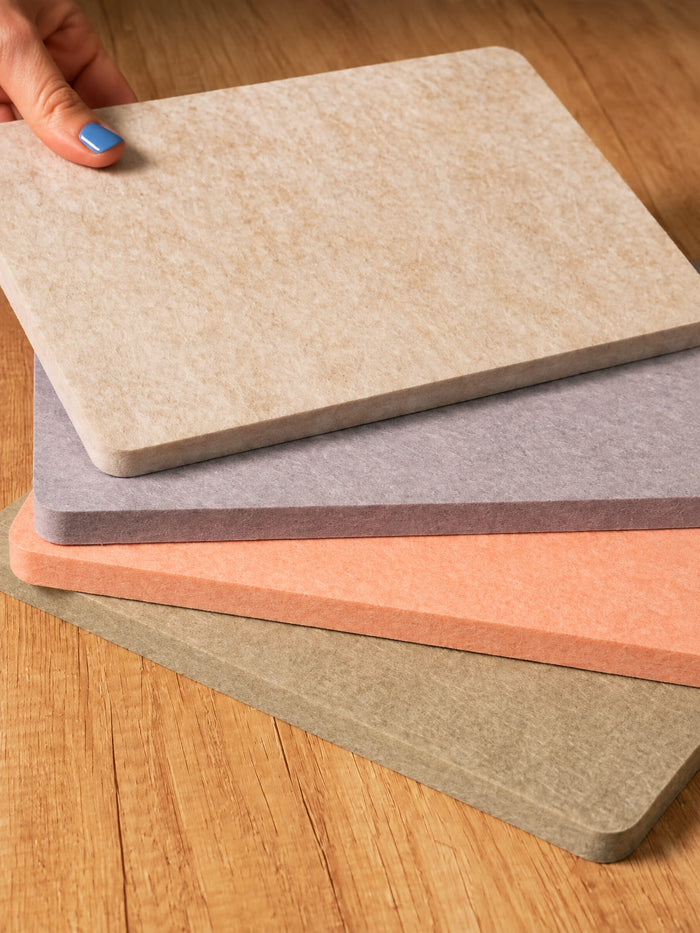
Custom CNC profiles. Where a project needs a specific pattern, logo or repeating shape, we cut to drawing. Custom colors are available to match a project palette.
Standard thickness options are 9 mm, 12 mm and 24 mm, with 40 to 60 mm available where stronger low-frequency absorption is needed. Tell us the finished sizes or send drawings, and we will confirm what the profile allows.
Planning Layout and Coverage
This is where most first-time buyers of 3D panels need the most help, and where a supplier should be able to advise rather than just quote.
Think in coverage area, not piece count. Acoustic treatment works on the total absorbing surface in the room, not on a single panel. A feature wall of several square meters will change the sound of a room. One panel will mostly change how the wall looks.
Decide the pattern before the quantity. Repeating grids are predictable and easy to install. Random or staggered layouts look deliberate but need a layout drawing. Ask for one before you order, so the installer is not improvising on site.
Leave a gap behind the panel. Mounting on a bracket or batten rather than glueing flat improves performance and makes the panel easier to remove or rotate later.
Plan the wall behind it. 3D panels add depth. Check that door frames, sockets, signage and lighting do not clash with the finished surface, and that the fixing method suits the substrate.
If you send us a floor plan or an elevation with the wall area marked, we can suggest a layout, a panel format and the quantity needed.
Fire, Emissions and Material Compliance
For commercial and public interiors, fire documentation usually decides whether a product can be used at all. Our PET panel material has been tested by SGS:
EN 13501-1 (Europe): Class B-s1,d0. Tested to EN 13501-1:2018 using EN 13823 and EN ISO 11925-2, on a calcium silicate board substrate, mechanically fixed, without joints. B-s1,d0 means limited contribution to fire, low smoke production, and no flaming droplets or particles.
ASTM E84 (United States): Class A. Tested to ASTM E84-2022, with a Flame Spread Index of 0 and a Smoke-Developed Index of 10. The tested sample was a 9.0 mm black panel.
Our panels also carry an A+ rating for VOC emissions, and recycled-material options are available where the specific material and order fall within the scope of our valid certification.
Two points that matter more than the headline grade:
A classification applies to the product as tested. The reports above cover flat panel material, mechanically fixed, on a specific substrate. A carved profile, a different thickness, a different color or an adhesive fixing is a different configuration. Tell us how the panels will be installed and which thickness and color you plan to use, and we will confirm whether the existing reports cover it. If they do not, we will say so rather than describe the product as meeting a rating without documentation.
Flame-retardant is not fireproof. PET panels can burn when exposed to a flame. Flame-retardant treatment reduces sustained burning after the ignition source is removed.
What to Send Us for a Quote
To price a 3D panel order accurately, we need:
Project location and application, with a photo or drawing of the wall if you have one Total coverage area, or the finished panel sizes and quantity Preferred profile or format, and the pattern if there is one Thickness, and whether stronger low-frequency absorption is required Color, and whether it needs to match an existing palette Installation method, and the substrate the panels will fix to Fire classification required by the project, including the standard Whether you need GRS or VOC documentation for the selected product Packaging requirements, including any private-label or own-brand packaging
Our terms: minimum order from 100 pieces, standard lead time around 15 days, and free samples with the customer covering freight. Custom sizes, custom colors and CNC cutting are available on request.
FAQ
Are 3D PET acoustic panels as effective as flat panels? They use the same material. Performance depends on total covered area, thickness, and how the panels are mounted. The 3D profile changes the visual result more than it changes the absorption, unless the built-up depth is substantial.
What NRC do your panels reach? Our PET panel is tested at NRC 0.80 and αs 0.70 as a 9 mm flat panel on a hard substrate. For a profiled panel or a different thickness, ask us what data is available.
Can you match a specific pattern or size? Yes. We cut to drawing with CNC, and we produce custom colors. Send the elevation or the pattern file.
Do you supply samples? Yes. Samples are free, and you cover the shipping.
What is the minimum order? 100 pieces.
How long is production? Around 15 days for a standard order.
Compare Panel Designs for Your Project
Use the specification checklist above alongside individual product pages. Compare the visual pattern first, then confirm the dimensions, finish, mounting arrangement and applicable reports for the product you intend to order.
- 3D PET acoustic panels and polyester fiber wall panels for material and profile enquiries.
- 3D acoustic wall panels and felt wall panels for dimensional finishes.
- Wave 3D panels and felt-laminated wave-grooved panels for flowing patterns.
- 3D triangle panels, geometric triangular panels and hexagon panels for geometric layouts.
Browse the full acoustic wall panel collection or send a project enquiry with the products you want to compare.